

Neuroscience Atlas Mapper
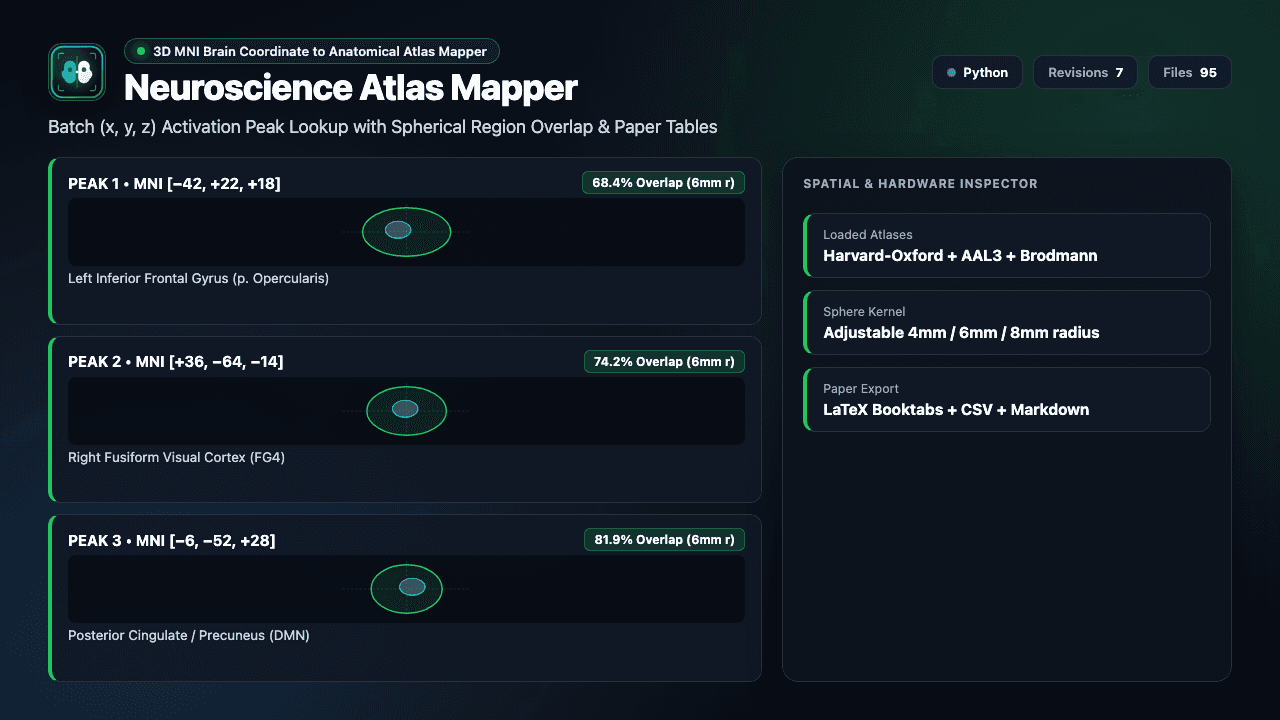
Load a spreadsheet of brain scan coordinates and get a table naming the brain region each one falls in.
Current status
Research script in development for mapping brain scan coordinates to anatomical atlas regions.
Overview
Research tool that takes lists of 3D brain scan coordinates `(x, y, z)` and automatically identifies which anatomical brain regions they fall into across standard atlases.
Why it was built
Brain imaging studies report activation peaks as raw `(x, y, z)` numbers, forcing researchers to look up each coordinate one by one across multiple brain atlases.
Why it helps
Reads a spreadsheet of brain coordinates and outputs a publication-ready table showing the exact anatomical regions and overlap percentages around each point.
What you can do
- Batch `(x, y, z)` brain coordinate lookup across standard neurological atlases
- Adjustable search radius around each activation peak
- Exports clean CSV and Markdown tables ready for research papers
Neuroscience Atlas Mapper — Verified Engineering & Visual Transformation
Brain imaging studies report activation peaks as raw `(x, y, z)` numbers, forcing researchers to look up each coordinate one by one across multiple brain atlases.
// Baseline manual workflow
// Problem: Brain imaging studies report activation peaks as raw `(x, y, z)` numbers, forcing researchers to look up each coordinate one by one across multiple brain atlases.Reads a spreadsheet of brain coordinates and outputs a publication-ready table showing the exact anatomical regions and overlap percentages around each point.
// Neuroscience Atlas Mapper verified pipeline
// Outcome: Load a spreadsheet of brain scan coordinates and get a table naming the brain region each one falls in.
// Status: Research script in development for mapping brain scan coordinates to anatomical atlas regions.0.7725 → 0.9395 (+0.167 · Sharpness +48.4% · PSNR 44.09 dB)Negation parity & evidence verifiedInteractive walkthrough
Step through how Neuroscience Atlas Mapper works without creating an account or installing local dependencies.
Entry & problem context
Maturity: In active developmentBrain imaging studies report activation peaks as raw `(x, y, z)` numbers, forcing researchers to look up each coordinate one by one across multiple brain atlases.
Research tool that takes lists of 3D brain scan coordinates `(x, y, z)` and automatically identifies which anatomical brain regions they fall into across standard atlases.
Shared platform architecture sandbox
Test the live cross-language single source of truth shared across TypeScript, Python, and Rust.
senior c++ and go ai engineerc++ · Acronym boundary: \mgo\M, \mai\Msenior and go ai engineerMultimodal RRF & temporal cluster boost
clip_alley_01: RRF 0.114426 · 1.20x temporal boost appliedclip_harbor_02: RRF 0.016393 clip_alley_01 (score 0.8427)Semiotic Brand Identity & Federated SoC Governance
Peircean Brand Mark, Multi-Size Squint Test & 3-Tier SoC Boundary

synapse_hexpublic_oss (max tier: oss_public)100.0% (non-redundant >15%) · Retired symbol trap: Clear (0 retired symbols)Engineering Velocity & Open-Source Hygiene
Synced from @brbrainerd and @vox-foundation via the GitHub GraphQL API (GET /api/github/stats).
Single-file full-stack programming language and Rust compiler that generates database schemas, server routes, and typed clients from one declaration.
Interactive political economy simulator with ECS civic rights, institutional modeling, policy levers, and multi-regime scenarios.
Interactive 3D macaque brain atlas and stereo surgical view planner rendered in browser WebGL.
Single-binary Rust and React kiosk shell for Raspberry Pi digital photo frames with remote mobile upload.